The Independent Electoral and Boundaries Commission (IEBC) is planning a major conference to review the legal and constitutional framework governing the management of election results, amid growing disagreements over how presidential votes should be transmitted, verified and declared in the 2027 General Election.
The conference will examine the management of results in the 2013, 2017 and 2022 elections, with electoral stakeholders expected to assess weaknesses in the existing system and propose improvements ahead of next year's elections.
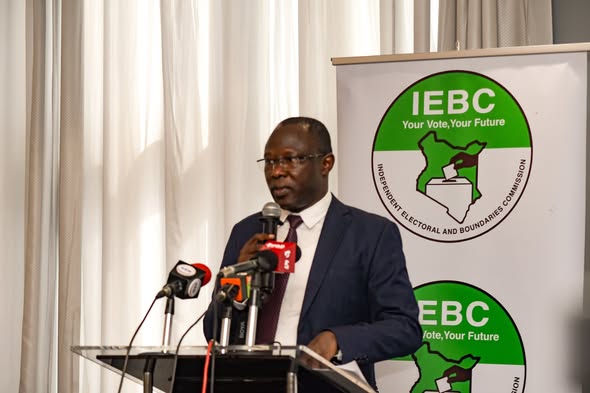
IEBC chairperson Erastus Edung Ethekon discussed preparations for the meeting during consultations with Felix Owuor, the Executive Director of the Electoral Law and Governance Institute for Africa (ELGIA), on Friday.
Commissioner Ann Nderitu accompanied Mr Ethekon during the meeting, which focused on organising the conference on Kenya's Constitutional and Legal Framework for Management of Election Results.
The initiative comes as the commission faces mounting pressure from opposition leaders seeking changes to the presidential results transmission and tallying framework, particularly the role of the National Tallying Centre in Nairobi.
The debate has centred on whether the national centre should undertake another round of verification and tallying or simply aggregate results already declared at polling stations and constituency tallying centres.
Mr Ethekon has defended the existing arrangement, insisting that the commission will operate within the law and the Supreme Court's interpretation of its mandate.
Speaking during a meeting with political reporters on November 24, the IEBC chairperson dismissed concerns that the national tallying centre could be used to manipulate results.
“I don't understand what is all this hullabaloo about the National Tallying Centre. The courts have said the results at the polling station are final. The rest is secretariat work,” he said.
He maintained that the commission was constitutionally required to collate, tally and verify presidential results before declaring the winner, arguing that the process was necessary to establish whether a candidate had secured more than 50 per cent of the votes cast and at least 25 per cent in 24 or more counties.
“We will make everything open, including the results. IEBC is not hiding anything and has not stopped anyone from accessing any polling station,” he said in a separate explanation of the commission's results management framework.
The chairperson also insisted that the Supreme Court had already settled questions surrounding the management of election results.
“The Supreme Court itself has settled the issue of election results management. Nobody in IEBC is saying that we are going to reinvent something else that is outside the law,” he said.
However, opposition leaders have argued that the existing framework leaves room for interference at the national tallying centre and want the results management system redesigned to strengthen transparency.
Former Deputy President Rigathi Gachagua has questioned the commission's preparedness to conduct the elections using the existing technology, arguing that IEBC should prioritise improving the current system rather than introducing an entirely new one.
“I still say that there is no time to procure a new system. I’m of the opinion that we should just improve on the existing system,” Gachagua said.
He has also challenged Ethekon to explain the commission's readiness, insisting that political parties and other stakeholders need clear answers about the systems that will be used in 2027.
“What Ethekon must tell us is the level of preparedness,” he said.
The former Deputy President is among opposition leaders demanding an independent audit of the voters' register, changes to the results transmission system and greater access to election data.
Former Chief Justice David Maraga has separately called for the removal of the national tallying centre, arguing that the process should not involve a fresh tallying exercise in Nairobi.
“We do not want retallying at Bomas,” Maraga said, in his argument that the IEBC's national role should be limited to declaring results already determined through the lower-level tallying structures.
The opposition has proposed a decentralised results management system in which the 290 constituencies and diaspora voting centres would have independent servers, with candidates, political parties and the media granted read-only access to results as they are transmitted.
The disagreement draws heavily on the experiences of previous elections.
In 2017, the Supreme Court annulled the presidential election won by former President Uhuru Kenyatta, citing illegalities and irregularities in the conduct of the poll, including failures in the transmission and verification of results.
The court ordered a fresh election, marking the first time in Kenya and Africa that a presidential election had been nullified by a court.
The 2022 presidential election also exposed divisions within the electoral commission after four commissioners disowned the results announced by former chairperson Wafula Chebukati.
The four commissioners questioned the manner in which the final results were handled, although the Supreme Court subsequently upheld President William Ruto's election.
It is these experiences that IEBC and ELGIA intend to examine during the proposed conference, alongside election results management practices in selected African countries.
The engagement is expected to bring together electoral officials, political parties, civil society organisations, legal experts and other stakeholders to interrogate the legal, constitutional and practical aspects of results management.
Among the issues expected to feature prominently are the transmission of results from polling stations, the verification of results forms, the role of returning officers, public access to election data and the responsibilities of commissioners at the national tallying centre.
The commission has maintained that results management must be transparent, verifiable and consistent with the Constitution.
In a statement following the consultations, IEBC said the conference would provide an opportunity to draw lessons from the three previous General Elections and undertake comparative analysis of electoral practices across Africa.